.svg)





Why standard analytics tools leave you stuck
Most e-commerce teams use Google Analytics, Mixpanel, or a CDP for funnel tracking. These tools are powerful - but they have a fundamental limitation when it comes to actually fixing conversion problemss.
They tell you what happened. They don't tell you why.
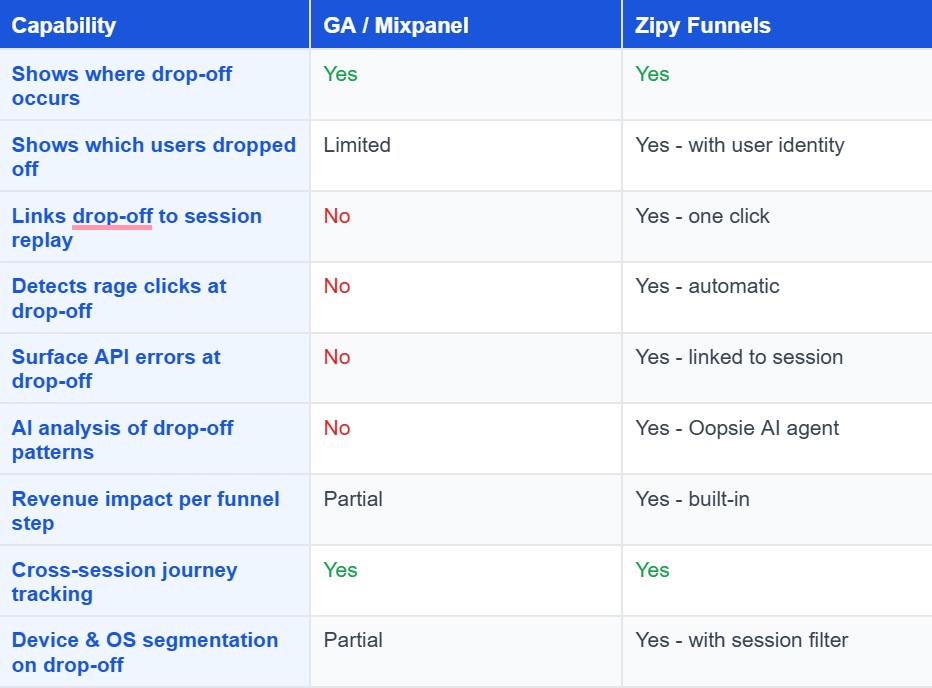
The gap in that table - the missing link between a drop-off number and the actual user experience - is exactly what makes Zipy Funnels different from a standard analytics tool.
Zipy Funnels across different e-commerce categories
E-commerce is not a monolith. A fashion brand, a consumer electronics store, an online grocery, and a D2C subscription business all have radically different user journeys, different drop-off patterns, and different friction points. Here's how Zipy Funnels serves each one.
1. Fashion and Apparel E-commerce
The problem: Users browse but won't commit
Fashion shoppers are highly visual and indecisive. They'll browse 12 product pages, add three items to a wish list, open the cart, and then leave without buying. The conversion killers aren't usually technical - they're experiential: wrong size, unclear return policy, slow delivery, or a checkout that asks for too much.
How Zipy Funnels help
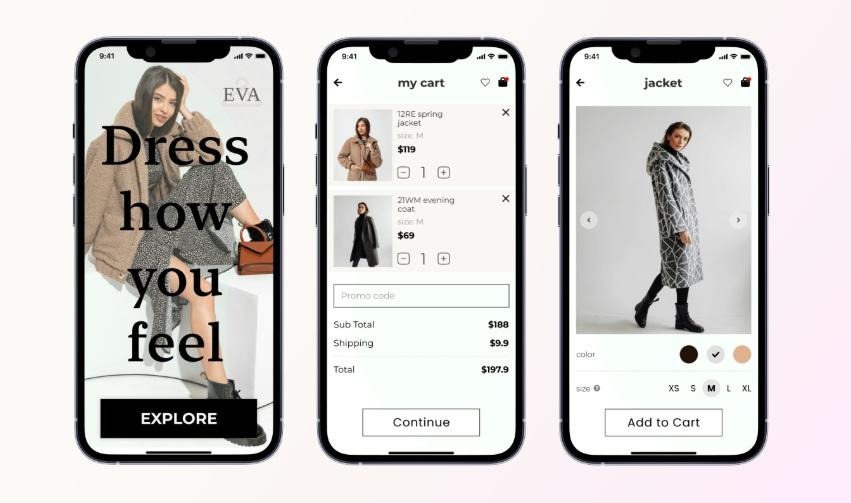
Fashion sites typically need to track size-selection friction and wish list-to-cart conversion - two steps that standard analytics tools often miss because they are not page navigations.
A typical funnel setup for a fashion store:
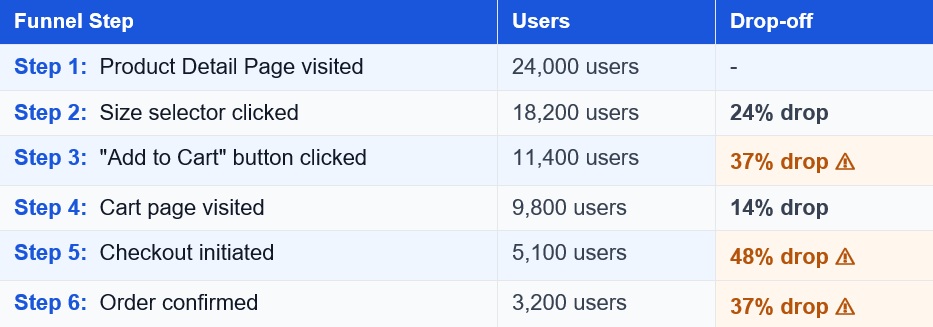
In this example, two red flags appear immediately: the 37% drop between size selection and Add to Cart, and the 48% drop at checkout initiation. Clicking on the size-selector-to-cart drop-off in Zipy opens session replays of those 6,800 lost users. Within minutes, a pattern emerges: mobile users on Android are hitting a size selector that collapses before they can confirm. It's a tap target bug - and it's been losing them thousands of units a week.
Key funnels for fashion sites
- Size/variant selection → Add to Cart - Finds friction in product configuration
- Wish list → Cart → Checkout - Measures wish list conversion effectiveness
- Search → Filter → Product page → Purchase - Optimizes the discovery-to-purchase path
- Returns page → Re-browse → New purchase - Tracks post-return recovery journeys
2. Consumer Electronics
The problem: Long research and high abandonment during comparison
The research for an electronic product may take days or weeks for a customer. They may spend time comparing the product’s specifications, read reviews, check the delivery time, and check the warranty options. After all this, they may drop out at the final stage of making the payment. The funnel here spans multiple sessions and multiple intent signals.
How Zipy Funnels help
Electronics sites need the Across Sessions funnel mode - because most customers don't buy on their first visit. A user who viewed a laptop three times, compared two models, and then initiated checkout is a very different signal than one who landed from a Google ad and bounced.
A Zipy funnel for an electronics site might look like this:
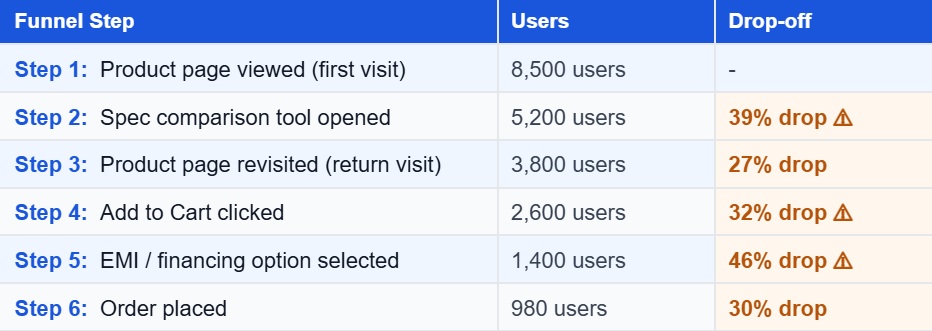
The 46% drop at EMI selection is striking. Opening those sessions in Zipy reveals that the financing calculator is throwing a JavaScript error for users with specific bank cards - but not crashing, just silently failing to show the monthly amount. Users see a blank field, assume their card isn't eligible, and abandon. The error was buried in the console logs, never surfaced by standard monitoring.
Key funnels for electronics sites
- Product view → Comparison → Cart → EMI selection → Checkout - Tracks the full research-to-purchase journey
- Review section scrolled → Add to Cart - Measures whether social proof drives conversion
- Warranty upsell seen → Accepted → Checkout - Optimizes upsell funnel effectiveness
- Stock alert sign-up → Return visit → Purchase - Tracks the out-of-stock recovery path
3. Online Grocery and Quick Commerce
The problem: Repeat customers abandoning due to slot and delivery friction
Grocery shoppers convert at much higher rates than fashion buyers - but they're also quick to abandon when delivery slots are unavailable, when substitutions are confusing, or when the checkout flow doesn't remember their preferences. Speed is everything. A 2-second slowdown on the cart page can kill the session.
How Zipy Funnels help
For grocery platforms, the most important funnels are session-scoped and time-sensitive. A user who puts milk, eggs, and bread in their cart and then drops off at slot selection is a solvable problem - but only if you can see it.
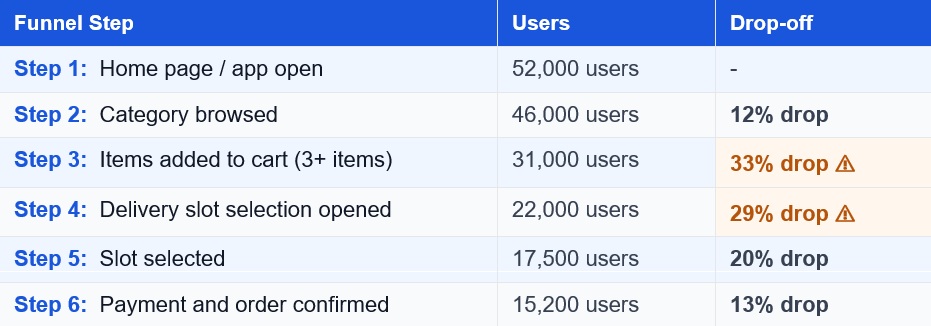
The 29% drop between opening slot selection and actually selecting a slot is the critical finding here. Zipy session replays show the answer instantly: users on iOS are tapping the slot calendar and the calendar is loading slowly - sometimes not at all - on low-bandwidth connections. The API call for slot availability is timing out at the 4G–3G boundary. A cached slot pre-load on cart add eliminates the problem entirely.
Key funnels for grocery/quick commerce
- App open → Search → Add to Cart → Slot selection → Checkout - Full session conversion funnel
- Repeat order initiated → Modified → Placed - Tracks repeat-order completion rate
- Substitution offered → Accepted → Order completed - Measures substitution acceptance impact
- Cart above ₹X → Free delivery threshold banner seen → Checkout - Optimizes free delivery upsell conversion
4. Direct-to-Consumer (D2C) Brands
The problem: High traffic from campaigns but poor bottom-of-funnel conversion
D2C brands often run aggressive performance marketing - Meta, Google, influencer - that drives high-intent traffic. But the gap between a well-targeted ad and a completed purchase is full of friction: landing page confusion, unclear product differentiation, subscription vs. one-time purchase complexity, and shipping cost shock at checkout.
How Zipy Funnels help
D2C teams are often product-led and data-lean. They don't have large analytics teams - they need tools that surface answers without requiring data engineering. Zipy Funnels gives them the ability to set up a campaign landing page funnel in under 2 minutes and immediately see where their ad traffic is bleeding.
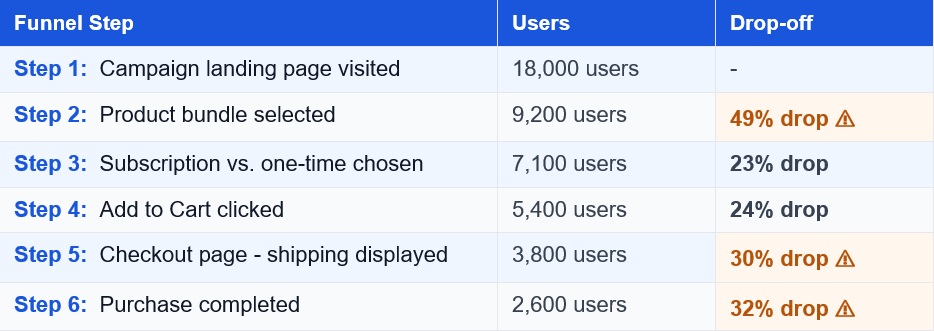
The 49% drop from landing page to bundle selection is the first shock. Session replays reveal the cause: users coming from a mobile Instagram ad are seeing a landing page designed for desktop - the product bundle selector is below the fold and most users never scroll to it. A simple layout change recovers thousands of lost conversions per week.
The 30% drop when shipping costs are displayed is a classic D2C problem. Zipy Funnels segments this drop-off by traffic source - and the data shows it's 3x worse for first-time visitors than returning customers. The fix: surface a shipping cost estimator earlier in the flow, before users commit psychologically to the purchase.
Key funnels for D2C brands
- Campaign LP → Bundle selector → Subscription toggle → Cart → Checkout - Full campaign conversion funnel
- Referral link → Product page → First purchase - Tracks influencer/referral campaign ROI
- Upsell offer shown → Accepted → Higher-value order placed - Measures post-cart upsell effectiveness
- Subscription cancellation flow → Pause offered → Retained - Tracks retention funnel success
5. Multi-Vendor Marketplaces
The problem: Seller quality and trust signals affecting category-level conversion
Marketplaces have a unique conversion problem: the product may be right but the seller may not be trusted. Users abandon at the seller rating step, at the return policy check, or when they see a new seller with few reviews. Funnels here need to operate at the category or seller level, not just site-wide.
How Zipy Funnels help
Marketplaces can create funnels that are unique to particular sellers or even product categories. This is done by taking advantage of Zipy’s user property filters and custom events.
Funnels created for "Electronics - New Sellers" versus "Electronics - Top Sellers" can quickly show if trust is a factor for sellers.
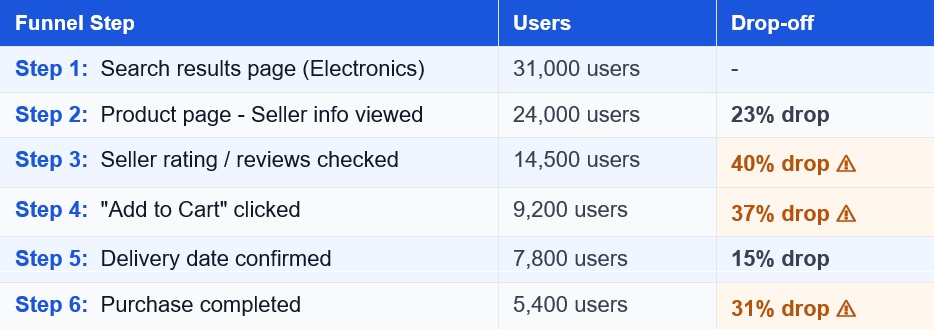
The 40% drop when seller ratings are checked reveals that users are looking at ratings and then leaving. Session replays show why: when a seller has fewer than 10 reviews, the rating section shows an empty star display with no text explanation - and users interpret this as a zero-star rating. Adding "New Seller - No reviews yet" copy recovers a significant portion of this drop-off.
Key funnels for marketplaces
- Search → Filter applied → Product page → Seller profile → Cart - Tracks discovery-to-commitment path with seller trust signals
- Product comparison viewed → Winner selected → Purchased - Measures comparison feature conversion impact
- Coupon code entered → Validated → Checkout completed - Tracks coupon drop-off and validation friction
- Wishlist added → Price drop alert received → Purchased - Optimizes wishlist-to-purchase nurture path
Setting up your first Zipy funnel in under 2 minutes
One of Zipy Funnels' most practical advantages is setup speed. You don't need a data engineer. You don't need to wait for an SDK event to propagate. You can define your first funnel in minutes and start seeing results immediately.
1. Define your conversion goal.
What does a successful user journey end with? For most e-commerce sites, it's a purchase. But it might be "added to wish list", "signed up for back-in-stock alert", or "completed onboarding". Start there and work backward
2. Map out the steps between entry and conversion.
Don't over-engineer it. Start with 3–5 steps. You can always add granularity once you've identified where the big drops are. A good first funnel for any e-commerce site is: Product page → Add to Cart → Checkout initiation → Payment → Order confirmation.
3. Choose the right type of step for each action.
Page navigations: "Page Visit URL". Button clicks: "Clicked Element Name". Form interactions: "CSS Selector". For events like "purchase_made": "Custom Event". Feel free to mix and match.
4. Set your session scope.
For checkout funnels and sign-ups, use "Single Session". For electronics, high-value items, or subscription products with a research phase, use "Across Sessions".
5. Click into drop-offs and watch the sessions.
This is where Zipy Funnels earns its keep. Every drop-off percentage is a doorway into session replays. Click the number, filter to "users who dropped off here", and watch what happened. The answer is usually visible within the first three sessions.
Pro tip: Enable revenue tracking in your funnel to see how much money is being lost at each drop-off step. A 37% drop at checkout initiation is alarming. A 37% drop that represents ₹48 lakhs in monthly revenue is a business emergency.
Zipy's AI layer: from data to diagnosis
Funnel data tells you where to look. Zipy's AI tells you what you're looking at.
AI-powered drop-off analysis
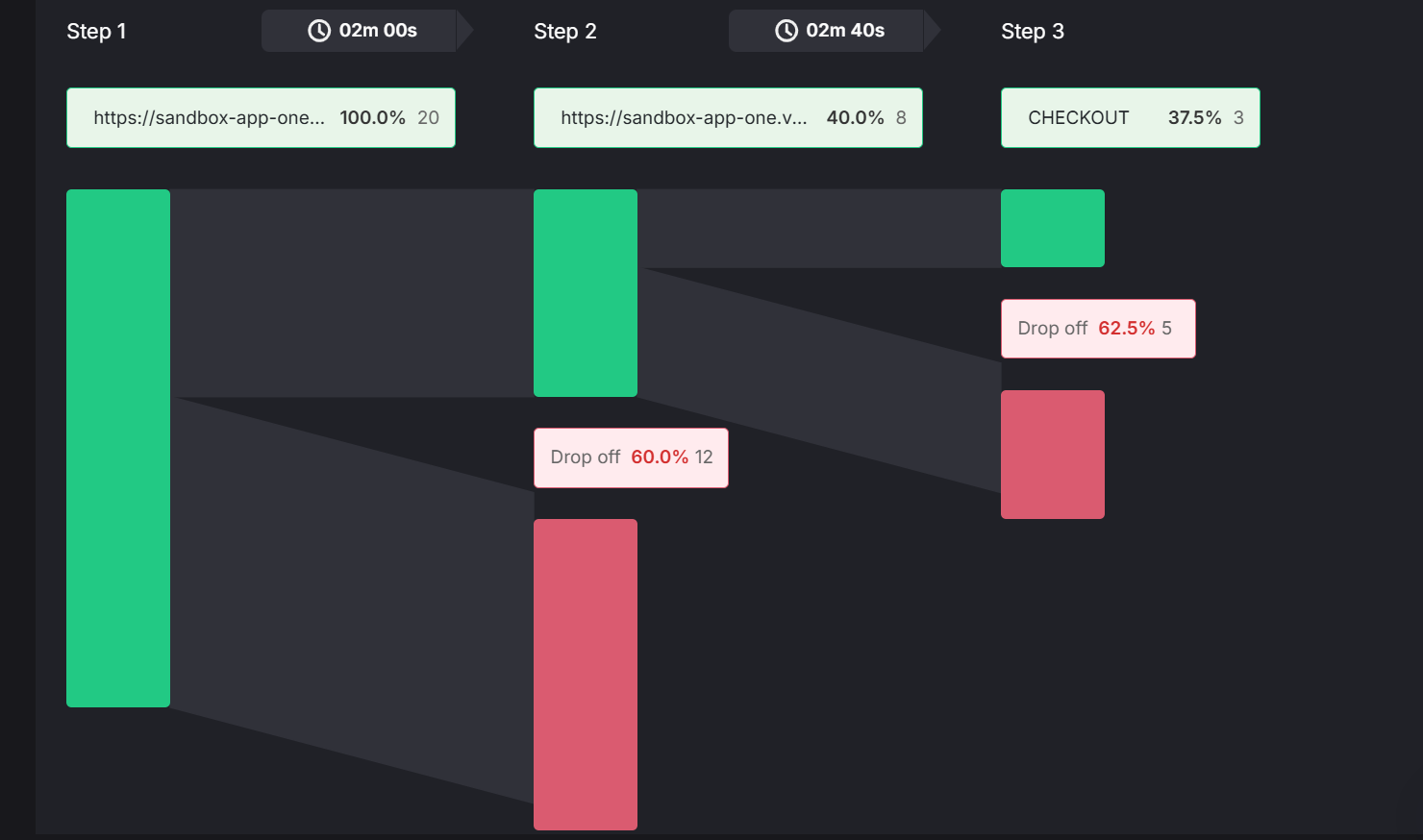
When you open a funnel step with high drop-off, Zipy's AI automatically analyzes the sessions of users who abandoned at that step. It looks for common patterns - rage clicks, form errors, API failures, specific device conditions - and surfaces them as categorized insights with severity scores and revenue impact estimates.
Instead of watching 200 sessions manually to find the common thread, Zipy AI watches them for you and tells you: "47% of users who dropped off at checkout initiation on mobile experienced a 3+ second page load. Linked to a render-blocking script in the payment SDK."
Oopsie AI agent: proactive funnel monitoring
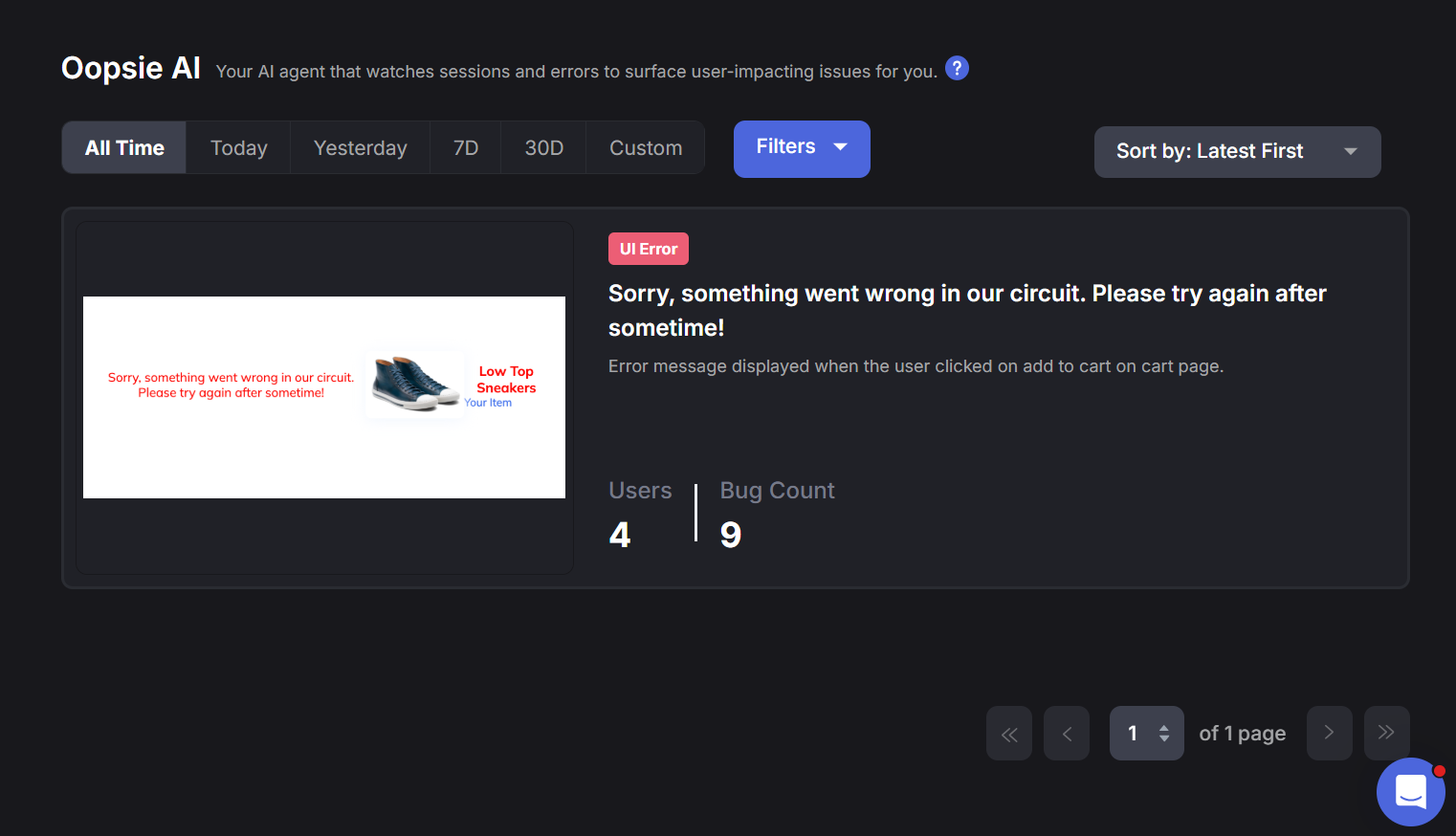
Oopsie doesn't wait for you to investigate. It continuously watches your conversion funnels for anomalies - sudden spikes in drop-off rate, new error patterns appearing in funnel steps, performance degradations that correlate with conversion drops - and alerts your team before a bad deploy wrecks a weekend's worth of revenue.
An Oopsie alert might say: "Checkout funnel conversion rate dropped 18% in the last 4 hours on Android. Correlated with deploy v4.2.1. Affected sessions show a blank payment form on Samsung Galaxy A-series devices." That's an alert you can act on in 30 minutes, not a mystery you spend three days solving.
Ask AI: query your funnel data in plain language
Zipy's Ask AI feature lets anyone on your team - product manager, marketer, or founder - query funnel data without building a chart. "What's the drop-off on mobile vs desktop for checkout?", "Which product category has the worst cart abandonment this month?", "Did conversion improve after the UI change last Tuesday?"
You ask. Zipy answers. No SQL. No dashboard engineering. No waiting.
Zipy + Claude: query your error data inside Claude (coming soon)
We’re building a direct integration between Zipy and Claude. Once live, you’ll be able to ask questions like “How many errors occurred on the checkout page between March 1 and March 15?” or “What were the top drop-off reasons last week?” - right inside your Claude chat, and get answers pulled live from your Zipy data.
No switching tabs. No opening dashboards. Just type your question in Claude and get Zipy’s funnel and error data back as a clear, conversational response. For teams that already use Claude as part of their workflow, this means your product analytics are one message away.
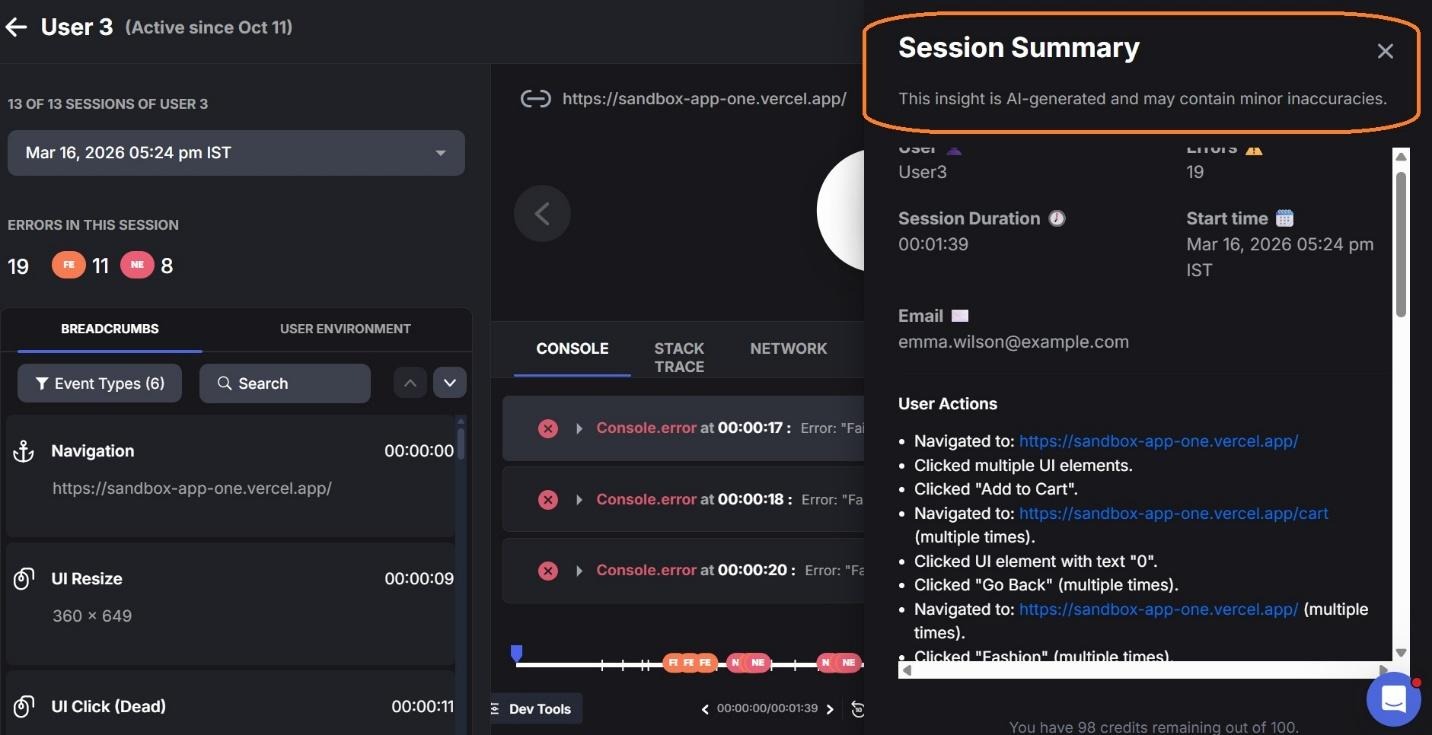
AI Summaries: instant insight at every funnel step
It highlights the most significant patterns for rage clicks, errors, device states, and revenue loss. This way, your team can respond instantly instead of wasting time exploring the problem.
- Error patterns: JS exceptions, API timeouts, and failed requests for drop-off users
- Behavioural patterns: Rage clicks, hesitation, and scroll depth
- Revenue impact: Calculated monthly revenue loss per problem
- Deploy correlation: Drop-off changes are automatically linked to the build that caused them
Conclusion: Funnels are not reports. They're investigations.
The reason most e-commerce teams build funnel charts and then don't act on them is that traditional funnels are one-way mirrors. You can see the numbers. You can't see the users.
Zipy Funnels breaks that mirror. Every drop-off percentage is a doorway into the actual experience of the users who left. Every number connects to a face, a session, a device, an error, a moment of confusion, or a frustration that can be fixed.
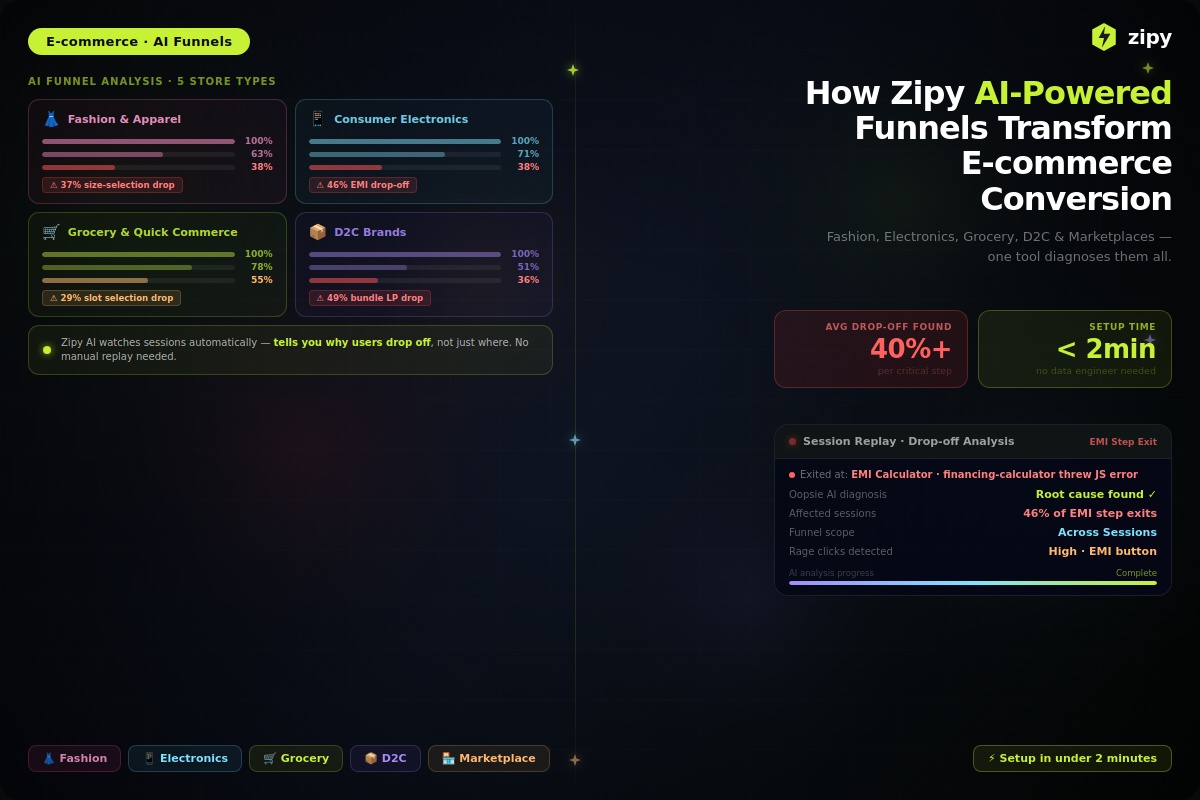
Whether you're a fashion brand losing customers to a broken size selector, an electronics store seeing users abandon at EMI selection, a grocery app with delivery slot timeouts, a D2C brand whose shipping costs are shocking users at checkout, or a marketplace where seller credibility gaps are killing category-level conversion - Zipy Funnels gives you the same capability: see exactly where users leave, and watch exactly why.
The drop-off is not the problem. It's the address of the problem. Zipy Funnels is how you walk through the door.
Frequently Asked Questions
What is funnel analysis in e-commerce?
Funnel analysis in e-commerce is the practice of tracking users through a defined sequence of steps - from landing page to purchase - and measuring where they drop off at each transition. A good funnel analysis tool doesn't just show you the drop-off percentages; it helps you understand why users left by connecting each step to behavioral data, session replays, error logs, and device context.
How is Zipy Funnels different from Google Analytics funnels?
Google Analytics shows you aggregated drop-off percentages and page-level flows. Zipy Funnels connects every drop-off segment directly to session replays of the users who abandoned - so you can watch what happened rather than just measuring it. Zipy also adds automatic AI analysis of drop-off patterns, rage click detection, API error correlation, and revenue impact tracking, none of which are available in standard GA funnel reports.
Can Zipy track funnels across multiple sessions?
Yes. Zipy supports both single-session and across-sessions funnel analysis. Across-sessions mode is particularly valuable for high-consideration purchases - electronics, furniture, insurance, subscriptions - where users typically research over multiple visits before buying. You can set custom time windows to define what counts as a valid cross-session conversion.
How quickly can I set up a funnel in Zipy?
Most e-commerce funnels can be created in under 2 minutes. You define your steps using page URLs, button names, CSS selectors, or custom events, choose your session scope and user counting method, and Zipy immediately begins analyzing. No code changes are required for page-level and element-level funnels. Custom event funnels require a one-time SDK instrumentation step.
What does Zipy's AI do with funnel drop-off data?
Zipy's AI automatically analyzes the sessions for the users who dropped off at each step in the funnel. It groups common patterns - things like slow page loads, form errors, rage clicks, API errors, or even device-related errors - and presents them as insights with severity and revenue impact. The Oopsie AI agent also actively monitors funnels for you and alerts you to increases in drop-offs, correlating them with recent deploys or performance events.
Is Zipy Funnels useful for mobile e-commerce apps?
Yes. Zipy has native SDKs for Android and iOS, and supports Flutter and React Native. Funnel analysis works identically on mobile - tracking app screen visits, button taps, and custom events - with session replays that capture the full mobile UI experience. Mobile-specific signals like ANR events, tap target failures, and network type are also available as funnel filter dimensions, making it easy to isolate device-specific conversion problems.


.webp)

.svg)